After the announcement of a second movie, following the release of Wicked, Nov. 21 can’t come fast enough. From the amount of brand deals, teasers, and additional songs being released to help promote Wicked: For Good, fans can’t help but expect a grand ending to this beloved story, and, of course, see what beautiful costumes are in store.
During the 2025 award season, Paul Tazewell was recognized for his outstanding work. He received numerous awards, most notably becoming the first Black man to win an Academy Award for Best Costume Design. He is now the second Black person to win in that category, following Ruth E. Carter, who made Oscar history by winning with her work on Black Panther.
With a grander story came extravagant costumes, and Paul Tazewell had to step up to the plate. With the characters evolving along with the story, Tazewell was given a heavy task, but, obviously, knocked it out of the park.
Glinda
For Glinda, Tazewell wanted her costumes to embody her signature glitz and elevated style, but with an added level of maturity. For PEOPLE, Paul Tazewell elaborates, saying, “She’s become much more of a politician. Because she is installed in the Palace at Emerald City, she wears clothes that are to her station and are elevated and very glamorous.”
At the start of the second film, Glinda is seen in a blue and lilac fairy tale gown as she descends from her bubble. Designed with
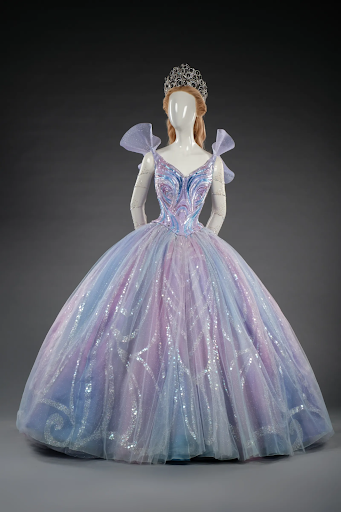 multiple layers of tulle and silk organza, the gown has a floating, lighter-than-air quality, which makes her look like a bubble herself. The bodice is intricately beaded with sequins and crystals, making Glinda sparkle from all angles. The silhouette is inspired by the dress Billie Burke wears as Glinda in The Wizard of Oz (1939); however, the blue color is also a nod to the original Glinda dress from the Wicked musical. As the film progresses, her look becomes simpler with Tazewell explaining for Vogue, “It was more about strong lines and getting down to the essence of who she is.” For the wedding ceremony, Tazewell went for a more contemporary style. Glinda dons a clean, full-skirted gown with an asymmetrical neckline and butterfly embroidery, accompanied by a 25-meter-long veil and a butterfly tiara, both described as metaphors for Glinda’s transformation.
In this sequel, Glinda is more than just a naive student at Shiz. Now she works for the Wizard, and given her importance within Emerald City, her wardrobe requires a different approach. Glinda is maturing into womanhood, but she’s also a pawn for the Wizard, manipulated into an icon of goodness. Tazewell continues, “It was this idea of Dior meets Marie Antoinette. She has this level of power, yet also has this soft and feminine quality to her.”
Elphaba
Elphaba has also matured, but her wardrobe captures this change in a completely different way. In this installment, Elphaba will be seen gravitating towards different clothing, such as pants that allow for greater mobility and expansion while also providing a modern touch. With her hat brim getting bigger and the peak becoming a little taller, everything she chooses to wear is intentional. Elphaba’s design also becomes more dramatic with an expanded cape, giving her more edge as she becomes widely known as the infamous Wicked Witch.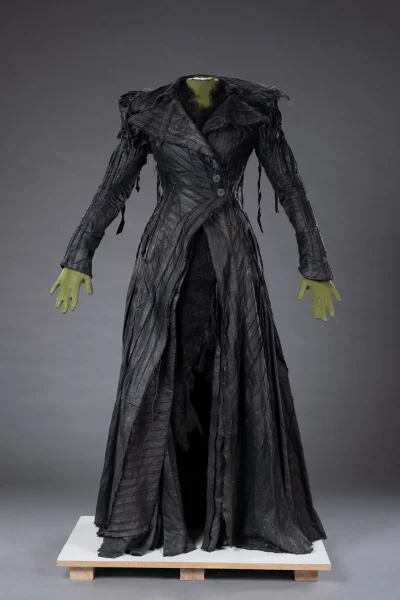
After Elphaba embraces her power and escapes Oz’s capital, Madame Morrible declares her a wanted “Wicked Witch”. She goes further into the forest, and we see her iconic black cloak deteriorate and become increasingly distressed. With Vogue, Tazewell notes that to see her costume degrade is to see “her shed all that that society has put onto her, to realize herself in a very honest and authentic way.” Later in the film, Elphaba goes to the Kiamo Ko castle in a different overcoat, and the audience sees how Elphaba is arriving at who she truly is. Tazewell adds that, “The coat is of Fiyero’s lineage, and that is represented in the black and blue ombré of the velvet cape and the tribal spiral pattern.” Paul Tazewell’s work reflects the shift in perspective, deepening the film’s two central characters.
Madam Morible and The Wizard
Madam Morrible possesses the same themes of power and royalty that shaped her look in the first film. To represent her reign over the Emerald City, Madam Morrible adorns all shades of emerald. Tazewell also references her magical powers, which include the ability to control the weather, with meteorological symbols, clouds, and smoke swirling around her dress. Tazewell even embellished one of her deep green velvet dressing gowns with silver and gold bullion embroidery to resemble lightning strikes exploding from the center of her body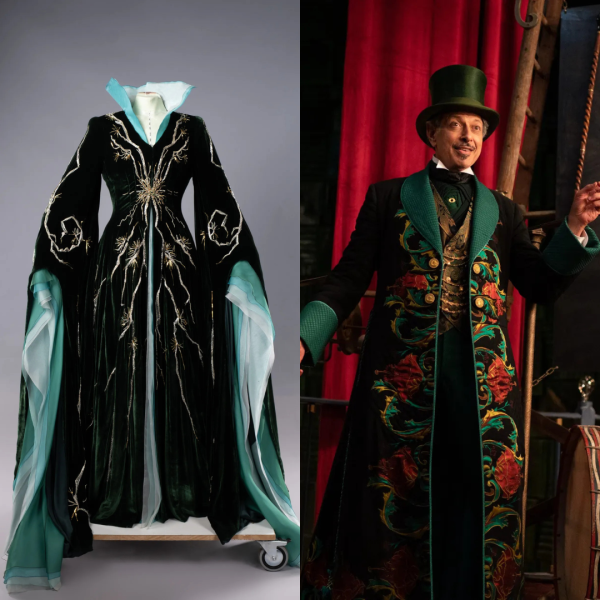
For the Wizard, Tazewell embraced a more theatrical—even campy—approach to costume design. “He is the one who has created all of the artifice that is so spectacular about Emerald City, and he carries that on his body as well,” Tazewell explains for Vogue. Drawing inspiration from classic circus acts, the Wizard’s wardrobe features ornate patterns, dramatic wide-lapel coats, and an abundance of top hats. Like Madame Morrible, his emerald accents signify authority and status, evoking the grandeur of a ruler firmly in command of Emerald City.
Ensemble
As love interests like Fiyero and Boq become more developed in Wicked: For Good, so do their costumes. As the Captain of the Guard, Fiyero is decked out in a dashing green and gold uniform, as Tazewell wants him to appear as charming as possible. When reimagining some of Hollywood’s most iconic characters, Tazewell aimed to make the original Wizard of Oz foursome feel recognizable, yet refreshingly new. Tazewell explains for Vogue, “That was hugely fun, to play with and manipulate what that image is.” He continued, “They needed to be identifiable as the four friends—you need to know exactly who they are when you see them and how they fit into Wicked. But I also thought that it was important to reflect the original Baum book.” He was equally deliberate in designing Boq in his Tin Man form. Tazewell explains that he took inspiration from some of the original illustrations, particularly the body’s silhouette and the funnel on the top of his head. In contrast, for the Cowardly Lion, Tazewell had to make a costume for a fully animated character, which he found both fun and exciting.
Conclusion
Coming from the huge success of the first movie, Wicked: For Good has a high bar to reach that was set by fans and critics alike. By releasing a second movie, John M. Chu, director of both films, told PEOPLE he wanted to give himself, the crew, and the cast the opportunity to tell the story of Wicked “as it was meant to be told while bringing even more depth and surprise to the journeys of these beloved characters.”
When reflecting on the expansiveness of both Wicked and Wicked: For Good, Tazewell says it was a Hollywood task like no other. “I am so fortunate as a designer to have the opportunity to create this kind of world,” he continues for Vogue, “It’s a privilege to be a part of an epic film that is telling a story as big as it is—and also as intimately as it is, because it relates to how we see each other and how we operate, hopefully, with empathy and love.”
Sources
An Exclusive First Look at Paul Tazewell’s Costumes in ‘Wicked: For Good’ | Vogue