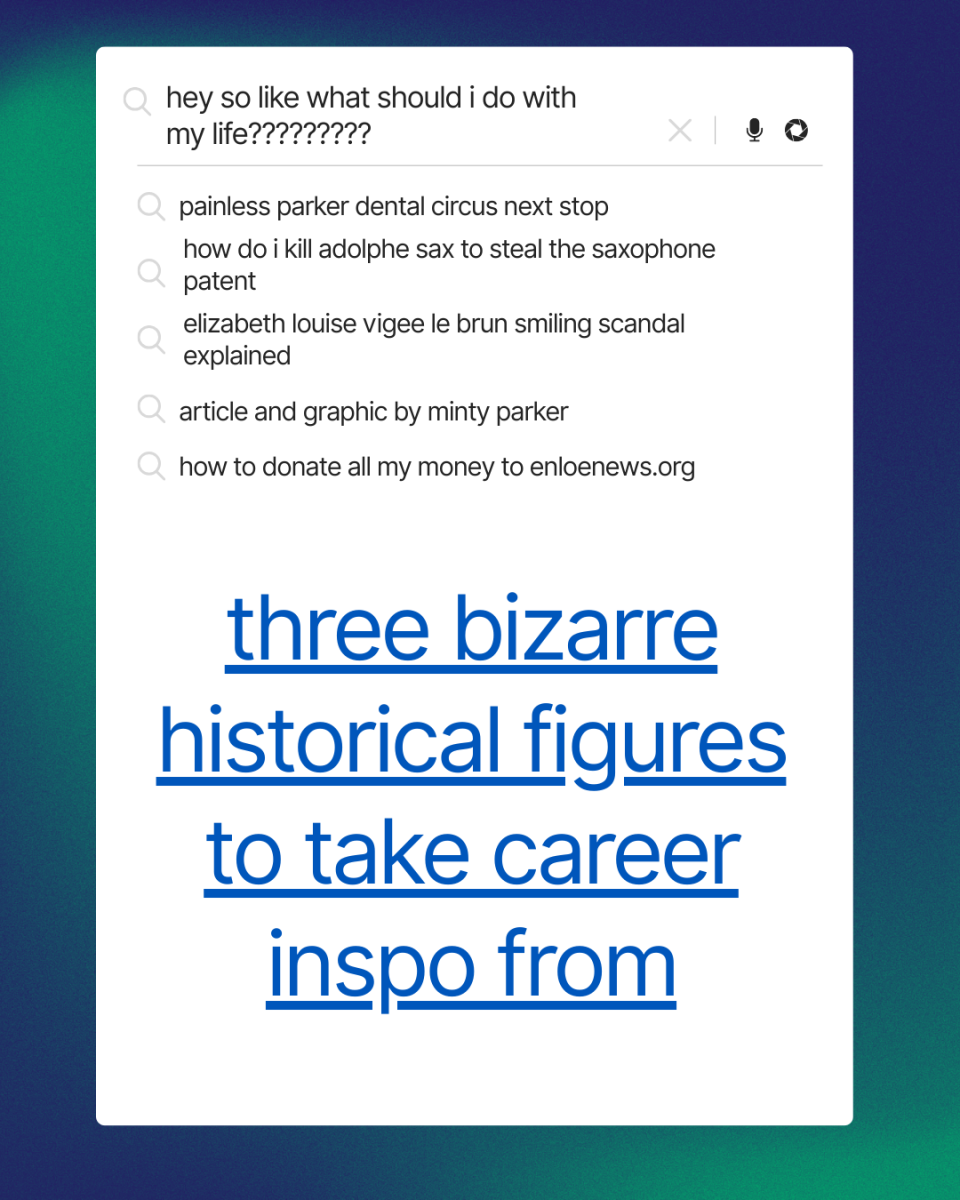
High school is a stepping stone. It’s a time to start thinking about your future and what you want to pursue for the majority of your adult life. Many Enloe students have lofty goals—doctors, political figures, artists… However, don’t forget, dear Eagle, that the options are endless. You have the potential to break the mold.
History doesn’t just remember the intelligent, the famous, and the rich—it also remembers the total weirdos, those who used their free will to the fullest extent. Conventional careers aren’t the end-all, be-all. If you’ve found yourself lost and floundering amongst peers who seem to know exactly what they’re up to, consider this list an inspirational guide. Perhaps not aspirational, but definitely a glimpse into some things you could, technically, end up doing. Here are a few brief biographies of historical oddballs to take career guidance from.
- Elizabeth Louise Vigee Le Brun: Side-Questing Portrait Artist
Elizabeth Louise Vigee Le Brun, born in France in 1728, was declared an artistic prodigy at the age of eight. At age twelve, she had a reverse-Cinderella moment when her father, a painter himself, died and was replaced by a rich man who insisted on wearing Le Brun’s father’s clothes.
She became the personal portrait artist to the Queen, Marie Antoinette, after her studio’s meteoric rise to prominence. She would quickly become a magnet for scandals, starting with her husband being publicly engaged to another woman at the time of their marriage, and rumors of her being a fraud and spending thousands on parties began circulating. Le Brun was labeled promiscuous for some truly bizarre reasons, including for displaying a self-portrait where she smiled with teeth and for painting the Queen in a cotton dress.
Le Brun was an anxious sort, and her anxieties were not eased when she started to come under attack by the French lower classes during the looming French Revolution. Le Brun was Antoinette’s favorite, so she had two options:
- Leave France.
- Get her head cut off.
Le Brun, smartly, chose the former. She and her daughter spent the next twelve years traveling Europe and painting, and overall, having a much better time than her family. Eventually, she moved to an apartment in London, where she had some unfortunate neighbors (the trumpeter for the Royal Guard who would start playing at 4 AM), then a beautiful manor with a less-than-desirable basement setup (the previous owner hid two dead bodies there), and eventually came to reside in a house most often described by her as “damp.” Not to be deterred, she continued painting and partying in the home.
After quite an impressive sequence of side quests that included her (dry?) home back in France being ransacked twice (once by the Prussians, once by the Brits), Le Brun would die at the age of 86 in 1842, having racked up quite the resume of experiences. Her tombstone reads: “Here, at last, I rest.” At last, indeed.
- Adolphe Sax: Unkillable Instrument Inventor
Adolphe Sax was born in modern-day Belgium in 1814, and no one expected him to last long. This was because, before he reached the age of adulthood, he fell three stories and was nearly presumed dead, drank acid thinking it was milk, swallowed a pin, was involved in a gunpowder explosion, fell onto a hot stove, almost asphyxiated due to being in the same room as drying furniture varnish, and fell into a river after receiving a concussion.
Sax retained just enough sanity from what was, one can only presume, a lot of brain damage to improve the design of the bass clarinet. It was obvious, then, why God wouldn’t let the man die. He invented the saxhorn (which would eventually become both the flugelhorn and the euphonium), the saxtuba, and, of course, the saxophone.
He also designed a few theoretical instruments, including the Saxotonerre, which was a train-powered organ, and the Saxocannon, which was less of an instrument and more of a comically large cannon. Sax estimated the weapon would be able to destroy a small city in a single blow. It was never built.
The saxophone was exceptional because it was a woodwind that was able to project incredibly loudly. His competitors were outraged, and they, naturally, began plotting his demise. This wouldn’t work: Sax was virtually indestructible. Beyond the attempts on his life (which did happen; in one instance, an employee of his was stabbed, having been mistaken for Sax), the lesser haters would find themselves challenged to a musical duel, and Sax would promptly kick their brasses. He had a massive ego and the skill to back it up.
Fortunately for Sax’s haters, he spent much of his life impoverished, declaring complete bankruptcy thrice. This was largely due to many lawsuits fought over instrument patents, and the workings of his competition in the instrument manufacturing industry to take him down: not only did they attempt to kill him, but they also burned down his factory and stole many of his patents.
Unfortunately, despite being able to survive poison, musically-driven assassination attempts, and, at one point, a tumor on his lip, Sax would eventually succumb to pneumonia in 1894. However, he is remembered to this day for revolutionizing music and for being a remarkably sturdy man.
- Painless Parker: Renegade Dentist
Painless Parker (first name Painless, last name Parker) was born Edgar R.R. Parker in the spring of 1872 in Canada. After a brief stint as a chef and a traveling salesman, he decided he ought to go into medicine. However, medical school was expensive, so he settled for dentistry.
After having to beg the dean of Temple University to let him graduate due to his previously practicing unlicensed door-to-door dentistry, Parker decided to make dentistry a spectacle, organizing a medical show where he traveled from town to town, pulling teeth in front of a streetside audience. After some success with this business model, Parker started his own dental practice in New York City. He advertised the Painless Parker brand heavily, saying that because of his recently-invented hydrocaine, which was mostly just cocaine, his patients experienced no pain at all. During performances of his “Dental Circus,” which included typical circus acts alongside dentistry, he would have a band play loudly to disguise the sound of his patients’ screams while he extracted their teeth. Parker was sued for false advertising.
Rather than sacrifice his brand, he opted to legally change his first name to Painless.
Despite having his medical license regularly revoked, the Painless Parker brand would grow to include 28 dental offices and create some of the first toothpastes and mouthwashes for at-home care. Despite his incredibly questionable medical practices, Parker did have a genuine desire to provide accessible and affordable dental care. He is credited with being one of the founding fathers of modern dentistry—dozens of regulations were put in place in an effort to protect patients from his antics. He has been called “a menace to the dignity of the profession,” “the drum-corps dentist,” and a “huckster.” He died in 1952, a legendary dentist and conman.
Ultimately, these three are people you might not necessarily want to be like in many ways. However, I consider them, beyond being amusing, a good reminder that success isn’t one thing. It can be earned through experiences, or through impact—and impact doesn’t always happen immediately.
Careers are funny things. It’s good to remember, as we set out into our lives, that things just might get weird. That’s ok though—it makes for a good story.
Sources
Bartlett, James. “Painless Parker: Part Dentist, Part Showman, All American.” BBC News, 11 May 2015, https://www.smithsonianmag.com/travel/remember-when-pulling-teeth-was-fun-180960448/. Accessed 18 Jan. 2026.
Baillio, Joseph, et al. Vigee Le Brun. The Metropolitan Museum of Art, 2016.
Billock, Jennifer. “A Brief History of America’s Most Outrageous Dentist.” Smithsonian Magazine, 28 Dec. 2016, https://www.smithsonianmag.com/travel/remember-when-pulling-teeth-was-fun-180960448/. Accessed 18 Jan. 2026.
“The Extraordinary Life of Adolphe Sax, Inventor of the Saxophone.” The Music Workshop Company, 16 Oct. 2020, https://www.music-workshop.co.uk/resources/blog/the-extraordinary-life-of-adolph-sax-inventor-of-the-saxophone/. Accessed 18 Jan. 2026.
Gihrig, Tim. “The Woman Who Won Paris (and Lost).” Minneapolis Institute of Art, 2 Aug. 2024, https://medium.com/minneapolis-institute-of-art/the-woman-who-won-paris-and-lost-86bac6a66d03. Accessed 18 Jan. 2026.
Inskeep, Steve, and Renee Montage. “Happy Birthday, Mr. Sax.” NPR, 6 Nov. 2024, https://www.npr.org/transcripts/361776541. Accessed 18 Jan. 2026.