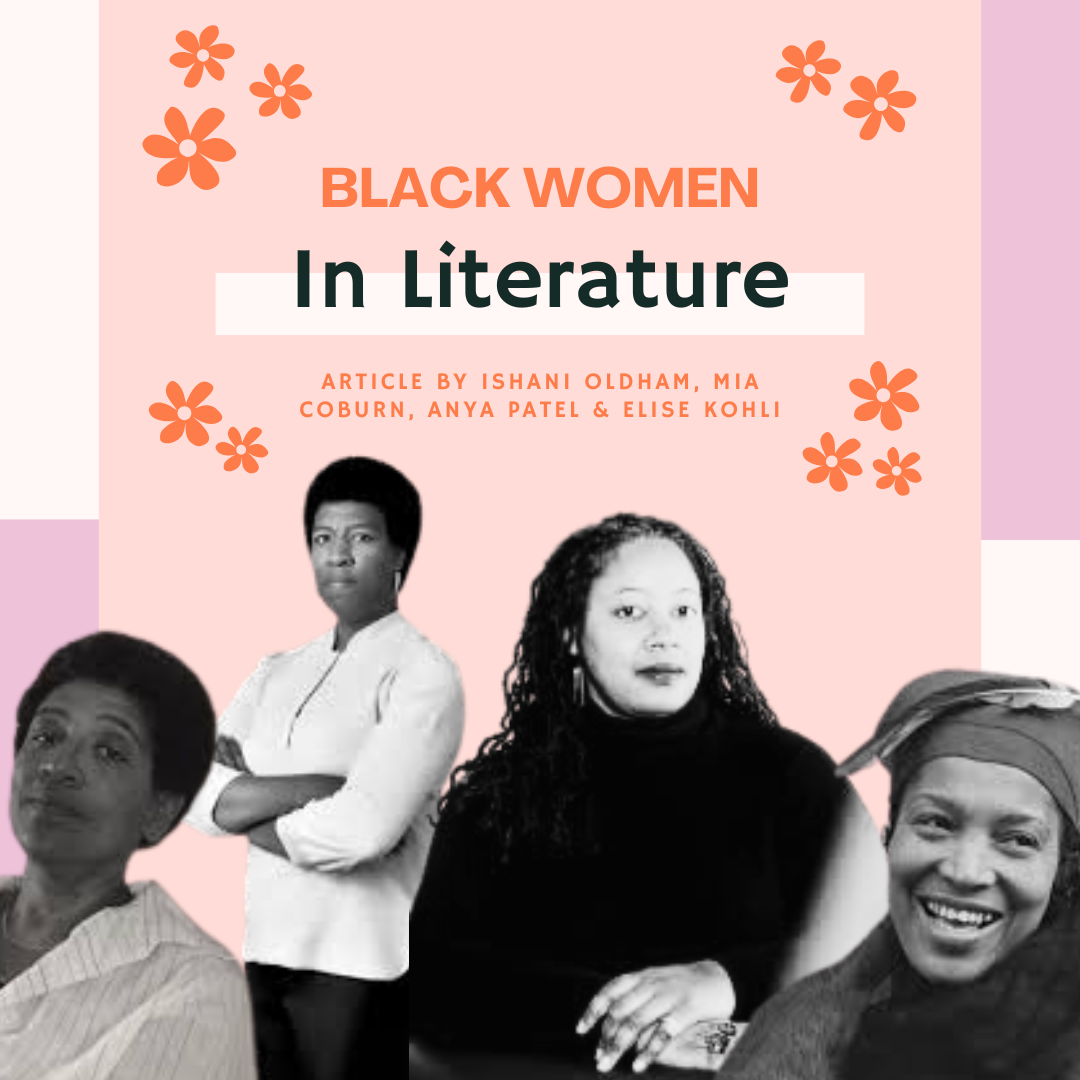
What better way to learn about Black history this February than through reading! Literature is a chance to immerse yourself in a range of perspectives within the human experience. “You read to expose yourself to stories you would not necessarily have been exposed to,” Enloe Assistant Principal and avid reader Ms. Jade Deberry said on the necessity of diversifying the authors we read. “You can learn from so many different people … If there’s one subsect of society that is heard from the least, there might be something we can learn from them.” The Eagle’s Eye previously covered a few of our favorite female authors for Women’s History Month. Now, we hope you enjoy this list of influential Black female authors, whose work has broken boundaries and uplifted underrepresented stories.
Octavia Butler
“My favorite author of all time is Octavia Butler,” said Ms. Deberry. Butler is considered to be the mother of the genre of Afrofuturism. Her works tackle themes of social and racial justice and are lastingly poignant to this day. She is often described by her biographers as “prophetic.” Her famous works, like 1993’s “Parable of the Sower” and the “Lilith’s Brood” trilogy, predicted a human experience that is strikingly like ours today. Each of her works displays a deep and nuanced understanding of the human psyche and the dangers it can bring about when unrestrained or enabled by the corruption of society. Ms. Deberry agrees that, as a reader, “A lot of [Octavia Butler’s] work … seems like she was a psychic. She could predict the future. She wrote about real-time human conflicts and what those conflicts look like in a science fiction context. Human conflict, political climates … she did it in a way that was relatable.” Despite critical acclaim, Butler’s writing was not well-received commercially in her own time. Her explicit discussion of discrimination and injustice against Black communities was affronting to many of her potential readers. It was not until her death in 2006 that the value of her works began to be discussed in the mainstream. She is now lauded for her ability to take dystopian science fiction worlds and use them to discuss sociological issues and environmental concerns. Her work openly opposes nuclear war and warns about climate change in a way that made her revolutionary for her time. Her prose is simple and frank, making it an accessible discussion of the realism of the social position of African Americans and women within the societies she invents and, as such, her own. Butler’s work is essential to understanding the power of the worlds of science fiction to hold a mirror to that of its readers.
Audre Lorde
Audre Lorde tackled the concept of intersectionality—when an individual experiences discrimination due to their overlapping marginalized identities—before it was widely defined or acknowledged. The daughter of Grenadian immigrants but a Harlem native, Audre Lorde was drawn to poetry as a young child, describing times as a young girl when she would recite poetry to express her feelings. After graduating from Columbia University with a Master’s of Library Sciences, she began work as a librarian and teaching at Tougaloo College, an HBCU in Florida. Her first collection of poetry, “The First Cities,” was published in 1968 and was followed by “Cables to Rage” in 1970, which contains “Martha,” a requiem for a former partner and a confirmation of her lesbianism. Lorde gained notoriety, though, after the publication of her third collection of poetry, “Coal,” which tackles themes of political injustice through her use of strong language and visceral imagery. The titular poem, “Coal,” is a celebration of her Black identity, while her poem “A Woman Speaks” calls on African spirituality to describe her power as a Black woman. Her poem “Power” was written in the midst of what Lorde described as a raw fury upon the discovery that a police officer who shot a young 10-year-old Black child was acquitted. As she identifies herself in her essay “There is No Hierarchy of Oppression,” this “Black mother lesbian warrior poet” deserves your attention this Black History Month.
Zora Neale Hurston
Heralded as the most successful and significant Black female author of the first half of the 20th century, Zora Neale Hurston is known for her portrayal of racial struggles in the American South. Growing up in Eatonville, Florida, the first incorporated all-Black town in the United States, Hurston saw evidence of Black achievement all around her, which was shown in her impact and contributions during that time. Referred to as the “Queen of the Harlem Renaissance,” she cared deeply about Black people and their culture. With a career spanning over 30 years, she published more than 50 short stories, plays, and essays, with “Their Eyes Were Watching God,” published in 1937, being her most significant work. Facing criticism at the time for its use of African American Vernacular English and the lack of focus on racial struggles, “Their Eyes Were Watching God” is now celebrated for its authentic portrayal of Black Southern culture and is hailed as one of the most important books in American literature, being taught in English classes at Enloe and other high schools in America. Throughout her life, Hurston dedicated herself to promoting and studying Black culture. Her legacy reemerged into the public consciousness nearly two decades after her death when writer Alice Walker wrote an article titled “In Search of Zora Neale Hurston” in 1975 for Ms., an American feminist magazine.
Tracy Deonn
Not only is Tracy Deonn an alumnus of the University of North Carolina at Chapel Hill, but her bestselling series “The Legendborn Cycle” is set at the university, with references to the old Chapel Hill Cemetery and the iconic bell tower throughout the novel. The protagonist discovers a secret society of demon hunters and navigates the challenges that come with being a Black woman in a historically white, male and discriminatory environment. Born and raised in North Carolina, Deonn reckons with the rich and complicated history of Southern culture and challenges the preconceived narrative of the South. As Deonn said for the “Southern Futures” podcast, “We need to reimagine the South because [it] was never portrayed with the layer of complexity that we are seeing now … that it has always had.” Deonn’s work is largely influenced by her mother, who passed shortly after Deonn began teaching at the UNC School of Communications and working for the university theatre company, Playmakers Repertory Company. This loss is mirrored in “The Legendborn Cycle.” The story begins after the loss of the main character’s mother. “[After my mother’s passing] I imagined, ‘what if there was an answer out there? What if there was an explanation for why bad things happen, and what kind of quest would that be?’” Deonn said for The Harvard Crimson, “ … ‘Who would be the person that I imagined would go on such a thing?’ And so I thought of, like, an angry grieving girl, and that was the beginning of Bree.” Deonn published “Oathbound,” the third installment in the “Legendborn” series, in 2025 and has confirmed a fourth book is on the way.
Alice Walker
As a short-story writer and poet, Alice Walker was deeply inspired by Zora Neale Hurston. Her legacy consists of seven novels, four collections of short stories, four children’s books, and volumes of essays and poetry. Known for her exploration of the lives, struggles, and strength of Black women, Walker’s “The Color Purple,” published in 1982, represents giving permission and hope for Black women’s resilience and rebellion. Additionally, it broke the silence around domestic and sexual abuse. Some critics believed it hurt relationships between Black men and women and criticized the overemphasis on Black male brutality within the novel. Despite the criticism, “The Color Purple” became her most popular novel, making Walker the first African-American woman to win a Pulitzer Prize, and it has been adapted for the stage and screen. Walker’s influence extends well beyond her writing, turning her attention to injustice wherever she saw it in the world. She worked as a social worker, teacher, and lecturer, and participated in Mississippi’s 1960 Civil Rights Movement and the 1963 March on Washington. In literature and life, Alice Walker’s legacy is her conviction, speaking out for human dignity, civil rights, and freedom.
N.K. Jemisin
The New York Times once called Nora K. Jemisin “The Most Celebrated Science Fiction And Fantasy Writer of Her Generation.” Best known for her groundbreaking “Broken Earth” trilogy, Jemisin has written countless celebrated novels and short stories. She is the first Black woman to receive the Hugo award for best novel, one of the literary world’s top honors. She has since won four other Hugos and much critical acclaim for her works of speculative fiction. Jemisin’s works are notable commentary on issues of social justice. For example, her “Broken Earth” trilogy is in part inspired by her thoughts on the 2014 protests in Ferguson, Missouri, which were in opposition to police brutality. She uses motifs of geology and terrain change in her work to express analogies to social change. Her world-building is complex and expansive, assisted by the way in which she draws on mythology to shape the settings of her stories. Jemisin is trained in psychology and often cites her own dreams as the beginnings of her creations. She blends literary techniques to create expansive prose that tackles the world of today without lifting the reader out of the world of fiction in which the story lies. Readers looking to immerse themselves in her body of work are advised to start with “The Fifth Season,” the first in her bestselling trilogy.
Gwendolyn Brooks
Gwendolyn Brooks is an influential and widely read author, with over 20 published books. Her most widely known works are “A Street in Bronzeville” and winner of the Pulitzer Prize in 1950 “Annie Allen.” The Pulitzer Prize is the most honored annual award for music, drama, literature, and journalism, and Brooks was the first African American to win this prestigious prize. Brooks was born and raised in Chicago, and much of her work reflects the experiences of African families living in urban neighborhoods. She wrote about everyday life, racial discrimination, poverty, hope, and resilience. Her writing style combined simple language and deep meanings, making her work relatable. In addition to winning the Pulitzer Prize, Brooks also served as the Poet Laureate of Illinois and later became the Consultant in Poetry to the Library of Congress, a position now known as U.S. Poet Laureate. She was deeply committed to supporting young writers and often visited schools and colleges to encourage students to find their voice through poetry. During the Civil Rights Movement, her writing became even more focused on Black identity, pride, and empowerment. Through her poetry, Brooks gave a strong voice to the Black community and became one of the most important American poets of the 20th century. Her legacy continues to inspire readers and writers today.
When asked about the importance of reading, Ms. Deberry said, “There are parallels between what is happening in our world and what is happening in these stories … reading about these things in a fictional context … helps you apply them to your own life.” It is a lesson well understood by many of these writers as they took the fictional works they created as an opportunity to shed light on the very real injustices faced by their communities and themselves. Their writing offers readers an opportunity to gain a deeper understanding of both themselves and the world around them through each character and narrative.
The media center holds a plethora of books by other notable Black female authors like Tiffany Jackson, Angie Thomas, and Nicola Yoon. We encourage you to browse their selection and find a good fit for your next literary endeavour. We hope that you find the time to experience one of these incredibly influential writers this February and in the months beyond.
Happy Black History Month!