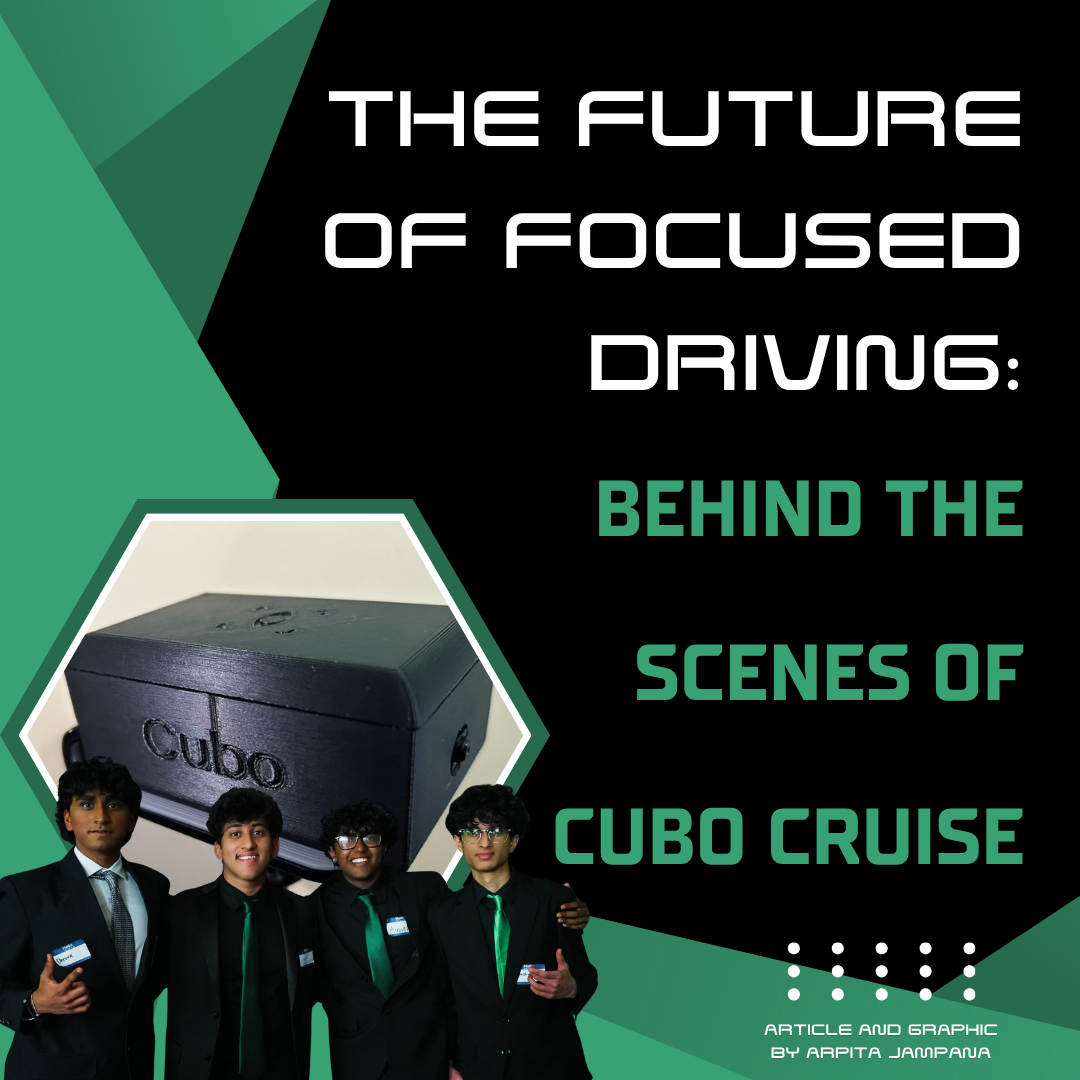
Every day, drivers are distracted, and even if it’s only for a split second, that brief distraction can have life-changing consequences. For teenagers specifically, distracted driving is one of the leading causes of fatal accidents. However, a group of student innovators in the Triangle hopes to change that with Cubo Cruise, a small dashboard device designed to keep drivers focused on the road. Using an AI-based facial analysis software and a built-in camera, Cubo detects when drivers look away from the road and alerts them until their attention returns to driving. What started as a simple student idea has quickly grown into a promising safety technology with national recognition and ambitious plans for the future.
This group of teenagers has been working together since Cubo was founded in December 2024 by CEO Dhruva Valluru, a current sophomore at Enloe High. His close friends and partners—CFO Gideon Merakanapalli at Green Level High, CMO Amogh Gotaparthy at Panther Creek High, and CTO Shashank Mantrala at Enloe High—have been working hard with him in their journey to make Cubo a safe and reliable technology for drivers. These sophomores who met at Carnage Middle School have come a long way from the plan that started in the seventh grade.
The idea began even before the boys could drive. “I wanted to get a car, but … teen insurance is so expensive,” Valluru said. “On top of that, a week later, [a student at Apex High School, Samantha Mele,] died from distracted driving.” Today, at least nine people are killed every day in the United States due to distracted driving, and over 3,000 people died in 2024 because of this problem. To resolve this prevalent issue, the team started working on Cubo Cruise, which would create a safer environment for all drivers and reduce deaths on the road as a whole. As a bonus, reports can be sent to insurance companies to receive benefits and lower premiums if you drive safely and undistracted consistently.
When the team started, they originally strived to raise awareness for the device by presenting Cubo at a national level to get funding and investors. Successfully achieving this goal, the Cubo team was the youngest ever to present at the Consumer Electronics Show (CES), the world’s largest technology tradeshow, held annually in Las Vegas. They also won second place in the Diamond Challenge, an entrepreneurship competition held in Delaware against 20,000+ high school students, and made finals for the Conrad Challenge, an international innovation competition for high schoolers. Adding on to these impressive accomplishments, the team was invited to present Cubo at MIT and worked with professors to publish a research paper. They also had the product reviewed by professors at both MIT and Carnegie Mellon.
Valluru reflected on the many experiences they learned from. “Not only have we learned [how to] compete in competitions better, [with] slideshow-making and presentations, but also developing … the quantum algorithm, learning models, coding AI learning models, [and] LTM models,” he said. He also explained how the team had to learn to handcraft their Printed Circuit Board (a mechanical base used to hold and connect the components of an electric circuit), a skill that was imperative to making Cubo official.
Valluru also expanded on the importance of this problem due to its ubiquity today. “[One of the top causes] of teen deaths is distracted driving, so it’s really important for students to be aware of the consequences of not driving properly, whether it’s driving drunk or distracted in general.” He adds that “It’s especially important for parents and students to be aware [of] Cubo so we can prevent such distracted driving and teen deaths from happening.”
Currently, Cubo is prelaunched, meaning a prospective buyer would have to contact the team to purchase the product. Future plans for the group include gaining 500-1000 parents as customers, fully launching to the public, and working with insurance companies in the next few years. They also strive to partner with pilot programs and legislation on an international scale in the future. As Cubo moves forward, its impact has the potential to extend far beyond a single group of teenagers. By combining technology, awareness, and real-world incentives, the team hopes to reshape how teenagers approach driving altogether. Readers can learn more about Cubo and follow the team’s progress through their website. Through its success, Cubo Cruise won’t just be a product, but part of a larger shift toward safer roads and smarter habits.