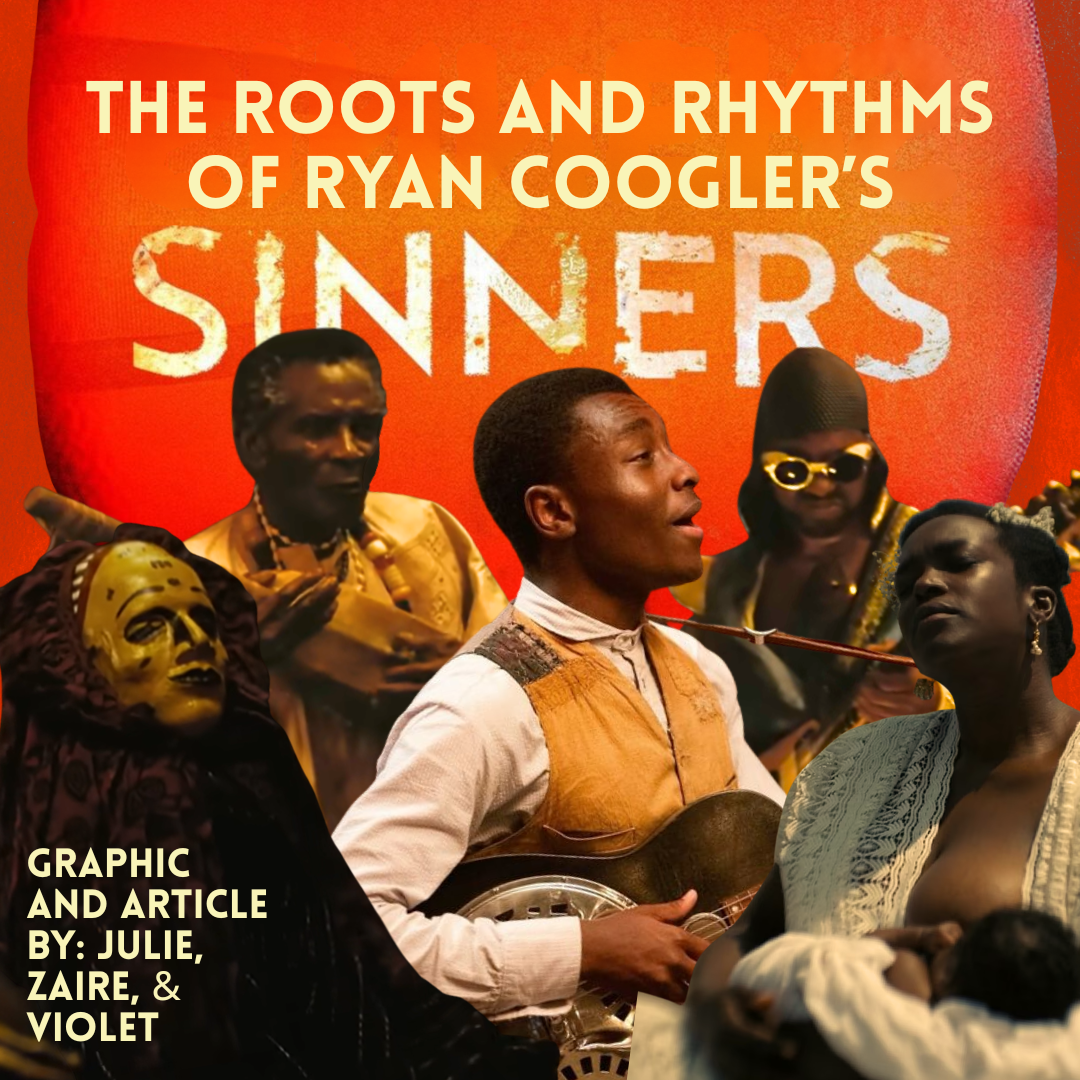
On April 18 2025, writer and director Ryan Coogler’s first original blockbuster, “Sinners,” hit theaters and impacted fans worldwide. The film is set in a small town in Mississippi, and is a picture of Southern gothicism. The film features a never before seen crossover of Black history, horror, and music. Both critics and audiences have been raving about the film since it came out, and this award season, it secured a record-breaking 16 Oscar nominations.
The year is 1932, and Jim Crow laws are commonplace at “the Devil’s Crossing” in Clarksdale, Mississippi. Two brothers, Smoke and Stack, return to their hometown after surviving WWI. They open a nightclub dedicated to Black cultural expression, with the ultimate goal of spreading peace.
“Sinners” is a powerful celebration of Black culture explored through the lenses of music, spirituality, and religion. By taking a Southern Gothic spin on the film, Coogler is able to place these topics in tension with each other. In the South, the genre of blues has regularly been regarded as “the devil’s music”, condemned by religious communities because of its associations with drinking, gambling, and sexuality. Coogler embraces the historical narrative in which religious doctrines frame secular art forms as sinful and corrupting.
Sacred versus secular expression, spiritual devotion and physical bodily experience, and respectability and authenticity all act as interlocking themes that expose the long, complicated relationship between institutional faith and Black artistic expression. The church may denounce the blues as immoral, yet Sammie’s music has the capability of transcending borders beyond the living and the dead. What is condemned as sinful is somehow also sacred at the exact same time.
We trace this tension back even further, to the West African tradition of the griot—a story-teller musician who preserves culture and traditions through song. One could argue that a blues musician is a griot themself. In this sense, blues goes beyond strictly entertainment purposes. It serves as ancestral testimony which holds the power to transform collective suffering into art. However, in the deep South, a blues musician is seen as dangerous. They’re someone who sold their soul to the devil in exchange for success, someone who fell into temptation, someone full of sin.
Coogler drew strong inspiration from musicians such as Robert Johnson, who is most strongly associated with the myth that his soul was sold to the devil at the Mississippi crossroads for fame. As Coogler explains in his NPR interview, these stories exist within a broader “tradition of things being taken.” Songs sung by Black artists were later performed by white musicians and rebranded for a peripheralized industry. A Black performer’s work could be reduced to just a “race record,” while the same song performed by a white artist would garner instant praise. At some point, society turned music into a class system—an exact reflection of the racial segregation that was happening in real life.
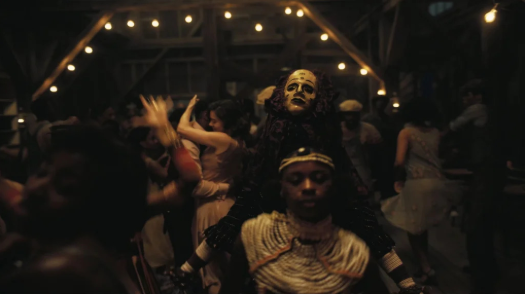
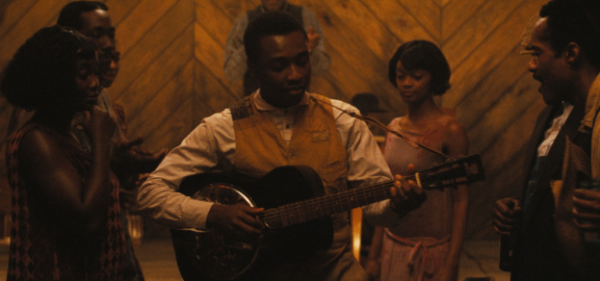
Raphael Saadiq and Ludwig Göransson’s Oscar-nominated song, “I Lied To You,” was a masterpiece that transcended not only generations but musical artistry. While performing in “Club Juke,” which is owned and run by Smoke and Stack (Elijah and Elias Moore), both played by Michael B. Jordan, their cousin “Preacher Boy” (Sammie Moore), played by Miles Canton, sings a song written for his father, the pastor. During his performance the room starts to fill with griots from the past, a 70s rock guitarist, a DJ from the 80s playing hip, and a West African man playing the drums, and more. Additionally, there were even modern characters, like futuristic Black women dancing and Black men Crip walking. As Sammie reaches the climax of his song there’s a vision of the roof burning down and everybody from different generations singing and dancing to their music as the club burns down. In this scene, Sammie reveals himself to the audience as a griot.
A junior at Enloe, Brilyn Goode, noted, “It’s something deep in [our] bones, we’re African American. Something resonates with African people and African music. Because that’s where we originally come from. I feel like griots are like bringing [us] in, reminding you of where [we] came from. And reminding you of how, even though all these things separate us, music brings everyone together, because everyone likes music in any way, shape or form. Our individuality may separate us as peoples, but music brings us back together.”
The storytelling of generations in this sequence is powerful. Be that as it may, Sammie’s dad, Jedidiah, didn’t approve of his son playing guitar for drunkards and philanderers, as he wanted him to follow his footsteps in the church. Much like Sammie’s love for music couldn’t be contained by his father, the fire represented how the music itself couldn’t be contained within the walls of Club Juke. During the beginning of the scene there’s a cut of Delta Slim, the comedic, alcohol-dependent, human embodiment of sin, saying to Sammie, “Blues wasn’t forced on us like that religion, no son. We brought this with us from home. It’s magic what we do, it’s sacred, and it’s big.” Slim has Sammie introduce himself before he sings, urging the boy to show himself off with pride. “I Lied to You” asks the listener to embrace and express their roots and their songs. Slim pushed Sammie to do just that. In his own way, Sammie acted as a preacher that night, not in the way of gospel but through strength, serenity, and sound; Sammie’s use of music to captivate the joints of people who had worked long days as sharecroppers, bringing them pride in who they are.
Enloe’s Black Student Union showcase this year highlights the progression of music throughout Black history, the theme being Our Roots, Our Rhythm. “I think music was an escape throughout history in all time periods,” said Enloe senior and BSU’s Showcase Coordinator, Tyler Butler–Figueroa. “It was an escape for enslaved people when they couldn’t read or communicate properly with other people. It really grew from rhythms and beats, it’s all connected somehow.”
The best thing about Sinners is the kaleidoscope of history, pride, and beauty all wrapped up in 2 hours and 17 minutes of film. Music is woven through Black history and will continue to represent the abundance of Black culture in the future. Make sure to check out Enloe’s BSU showcase today on February 25 at 6:00 PM, and watch Sinners this February to celebrate Black History Month!
Sources
https://www.goldderby.com/film/2025/raphael-saadiq-sinners-i-lied-to-you-interview/