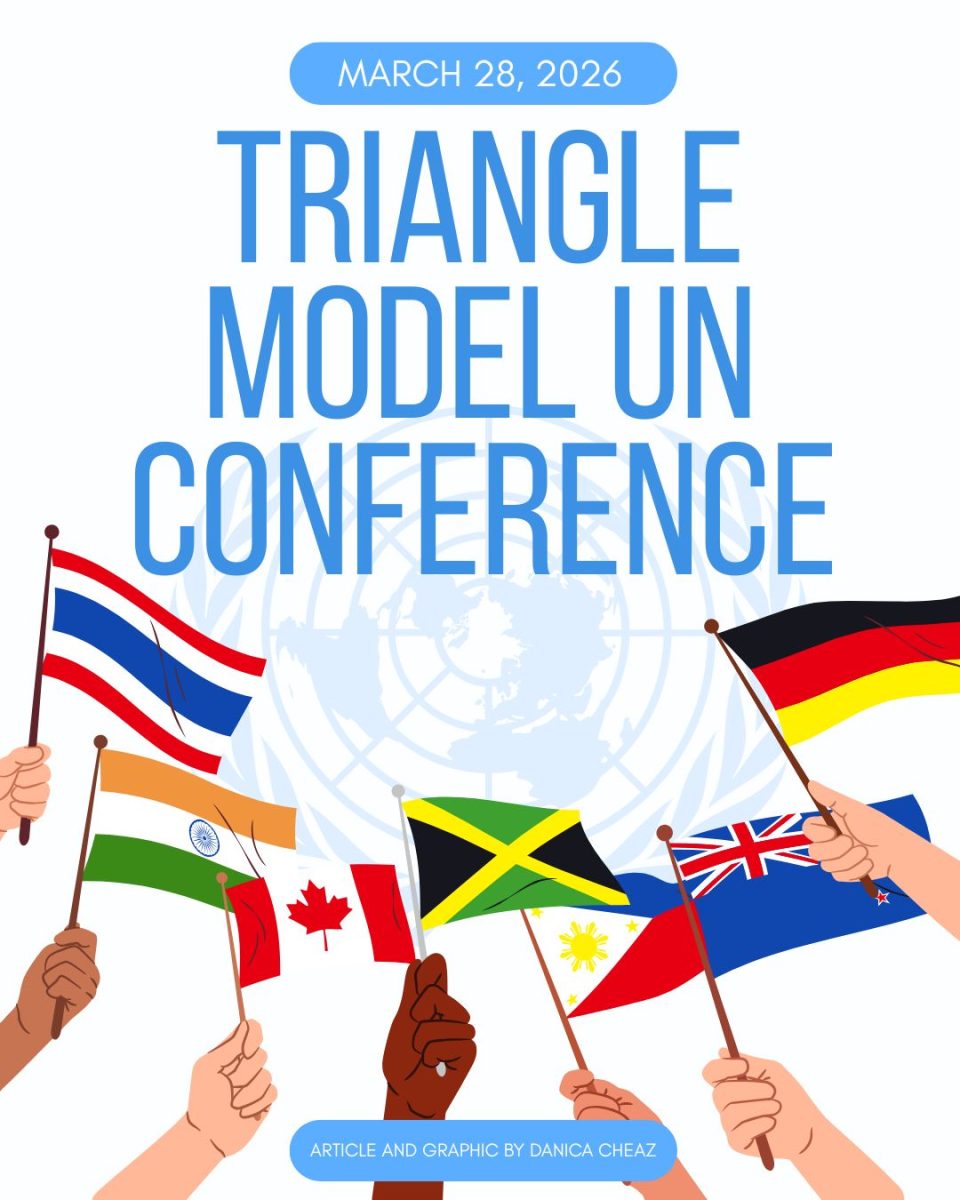
Today, March 28, the Triangle Model United Nations Conference (Tri-MUNC) will hold their fourth annual conference, bringing together schools from across The Triangle to compete at Enloe.
There are three different committees that participants, termed “delegates” in Model UN, can choose from: General Assembly (GA), Specialized Agency (Spec), and Crisis. In GA, each delegate represents a different country, basing their decisions on the values of their chosen country, and work together to pass a bill on a specific policy of interest. Spec follows the same general structure, but their topics are more specific and may require more research to prepare. Lastly, Crisis is more fast-paced and individualized than the other committees. Delegates represent a single person, such as a councilmember, and work in small groups to respond quickly to emergencies, incorporating incoming updates in real time.
This year, Tri-MUNC is focusing on the modernization of the UN declaration of human rights in GA, the Louvre Heist in Spec, and The Hunger Games in Crisis.
What sets Tri-MUNC apart from other Model UN conferences is that a coalition of Model UN leaders from different schools are working together to organize the event. Normally, a single Model UN chapter will organize a conference and invite others to participate.
To prepare for a Model UN conference, delegates first sign up for the committee they want to participate in. Then, they write their position paper, an essay detailing the delegate’s character, their stance on the issue, and what they want to accomplish in the committee. Lastly, all speeches for Model UN are prepared during the committee, nothing is pre-written. Delegates may have to keep up with live updates from the issue, and adjust accordingly.
This year, along with standard awards such as best delegate, outstanding, and verbal commendation, Tri-MUNC will additionally be granting one position paper award per committee for delegates who have shown excellent research and knowledge through their paper.
Event Organizer Hannah Elman, a junior at Durham Academy, says “I really, really enjoy being able to think creatively, and you also make a lot of friends.” She continues, “College conferences go for the entire weekend and you’re together from 8 a.m. to 5 p.m. Three days in a row and you’re talking to everyone, and so by the end of it, you guys have spent 72 hours together … [and] you make a lot of friends.”
Elman says that through Model UN, “You learn a lot about how to be diplomatic and professional.” She testifies that one of the biggest things she has learned from Model UN has been being able to “speak human words” in the heat of the moment. “Brains are not designed to think on the spot. They’re designed to go into fight, flight, or freeze responses … and you’re not able to use your critical thinking skills,” she explains. “Being able to pull yourself into [critical thinking] is a skill because you’re not innately born with that.”
Elman says that one of the hurdles of Model UN is: “I know this in my brain, and I know what I’m talking about. But how do I connect that to you in a way that you’re going to understand?”
Elman emphasizes Model UN as a place to learn. “You’re gonna learn how to think on your feet, you’re gonna get really good at presentational speaking and writing, you are gonna learn a lot about how other people think and process information, and you’re gonna learn how to use that to get your point across effectively,” Elman concludes.