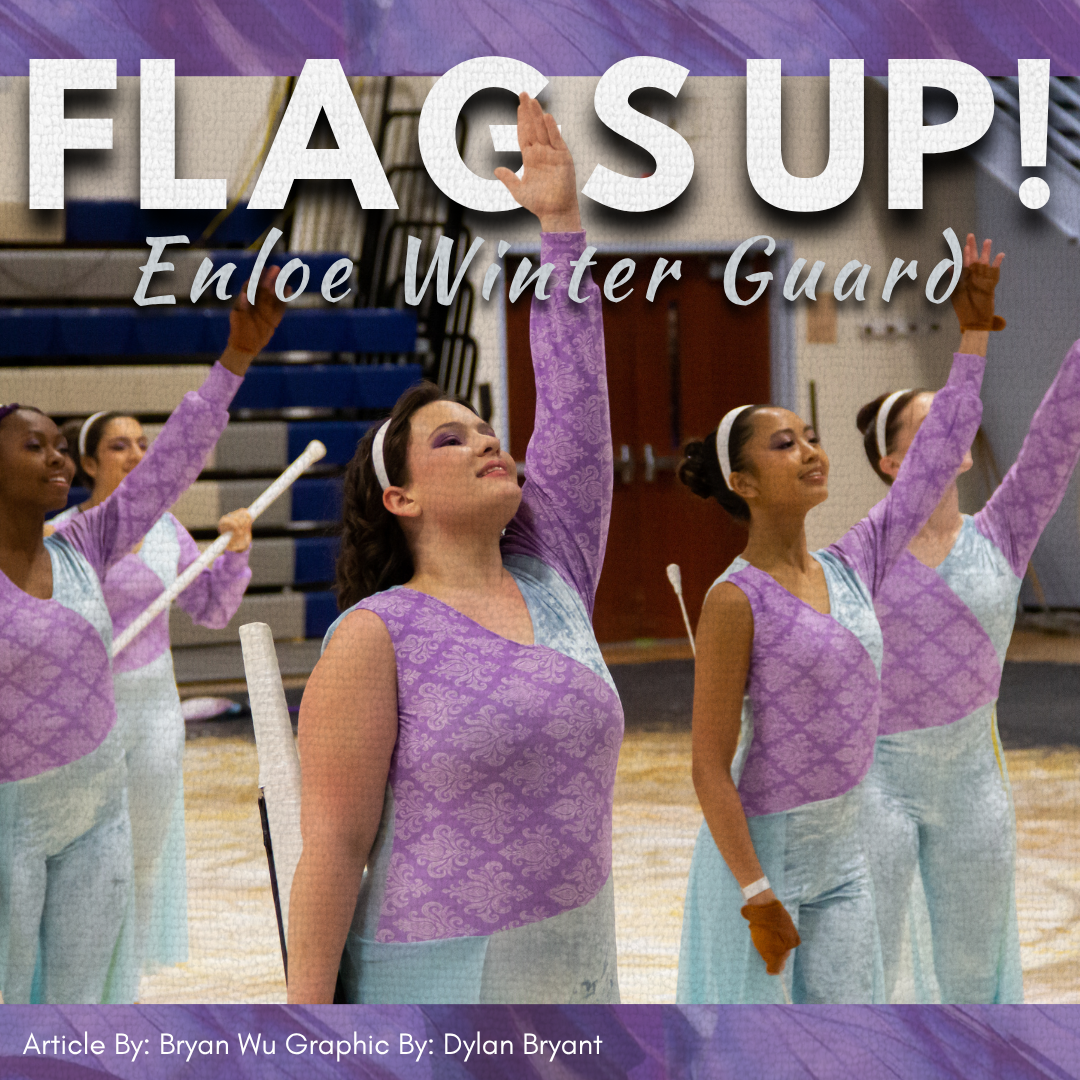
Could you survive this: 12 hours of running and flipping heavy rifles on weekends and teacher workdays, practicing every step to be on beat for 10 hours a day, five days a week during the summer, or competing with schools all over the country to perfectly showcase your months of practice? If you couldn’t, it may be time to start looking up to the Enloe winter guard, who do exactly that every year. With rifles, sabers and flags, there’s a lot to perform at a winter guard competition. Performances must be perfect, and the fierceness of practice makes sure of it.
To begin practice, the winter guard must set up and warm up to ensure both their environment and bodies are ready for practice. The members first roll out a 300-lb decorated floor mat which they will actually use at competition. When constantly tossing and twirling objects as large as the winter guard flags, drops are inevitable which can damage gym floors, making the mat a necessity. Additionally, having the mat out makes practice feel more like the environment of an actual competition. With the mat out and songs by the likes of Britney Spears and Sabrina Carpenter blasting, the guard starts with active warmups. These general warmups are not just for the body; they’re also for staying on beat. As members run, jump and chassé across the gym, instructors Sara Shields and Ashley Tomanelli count fiercely, “One and two and three!” At the winter guard, rhythm and timing are just as important as perfecting any toss.
When these general warmups are finished, the guard moves on to practice flag, rifle and saber separately. Each equipment practice follows a similar structure: equipment-specific warmup, isolated skill exercises and lastly, choreography. “There [are] so many responsibilities,” says Shields. “[At practice] we’re having to build strong technique, their ability to move, dance technique, equipment technique, how they spin flags, how they toss flags, how to move on the floor… We’re constantly working on those skillsets.” Taking flag as an example, a common warmup is “around the world” where members hold and rotate a flag in front of them. Although around the worlds are just a warmup exercise, Shields and Tomanelli emphasize synchronization. Members constantly count beats aloud to ensure everyone stays on rhythm. In a team-oriented environment such as winter guard, communication is the key that enables the fluid movement audiences see on the field.
When finished with equipment-specific warmups, the guard moves on to practicing isolated skills specific to flag, saber or rifle. Continuing with the flag example, drills include flag tosses at various timings and numbers of rotations. Winter guard’s instructors pay close attention to every aspect of the exercise, from foot placement to even the angle of the flag when it is caught. Only after their many warmups and drills is the winter guard ready to practice their choreography. At this point, timing is just as crucial as the equipment tricks themselves and every step must be intentional in distance and rhythm. Oftentimes, the guard is partitioned into groups that each have their own timings separate from the other groups, making it even more difficult to stay on time, yet all the more impressive for the audience. With such complex timings, the choreography is by no means rigid and goes through constant fine tuning during practice. Shields and Tomanelli notice when certain timings are awkward for members and experiment with changing the beats for smoother transitions. “Can we” and “let’s try” are commonplace at winter guard practice, showing the team’s flexibility and effort to get everything just right.
For the instructors, however, practice is more than just an opportunity to perfect the team’s impressive performance. “Our number one goal as instructors is to build strong kids. We want to build strong work ethic, teamwork, time management, leadership, all that stuff. We’re building good humans before we even work on [winter guard] skills,” says Shields. Tomanelli adds, “Accountability is a big thing. A lot of our kids go on to do a lot more with the program in college and/or independent guards, and they expect a lot more, so it has to start at the high school level in order for it to carry over.”
For the members, each one has their own favorite and least favorite part of practice. Some cite learning choreography and winter guard-specific skills as their favorite part of practice, while others simply enjoy being with their close friends. Member Isabelle Augustine says that her favorite part about practice is being able to learn new tosses with friends. Meanwhile, member Rakshika Birla says her favorite part of practice is learning rifle. However, almost every member cited either warm-ups, cardio or refolding the floor back up at the end of practice as their least favorite part. With a team that’s as passionate as the Enloe winter guard, it’s unsurprising that their least favorite parts of practice are all the parts that don’t directly correlate with winter guard.
The Enloe winter guard is awe-inspiring and always worth watching. Although winter guard’s season is coming to a close, those interested in learning more or watching a performance can watch Enloe’s color guard, who do similar performances as the winter guard but with the marching band in the summer.